Edited to add: I’m shooting for the mid- to late 1st century. When the stola was reserved for the wives of Senators and going out of fashion. I haven’t fully defined my persona, or time period, so I slide a little back and a little forward. My next tunica will slide even more forward and have clavii!
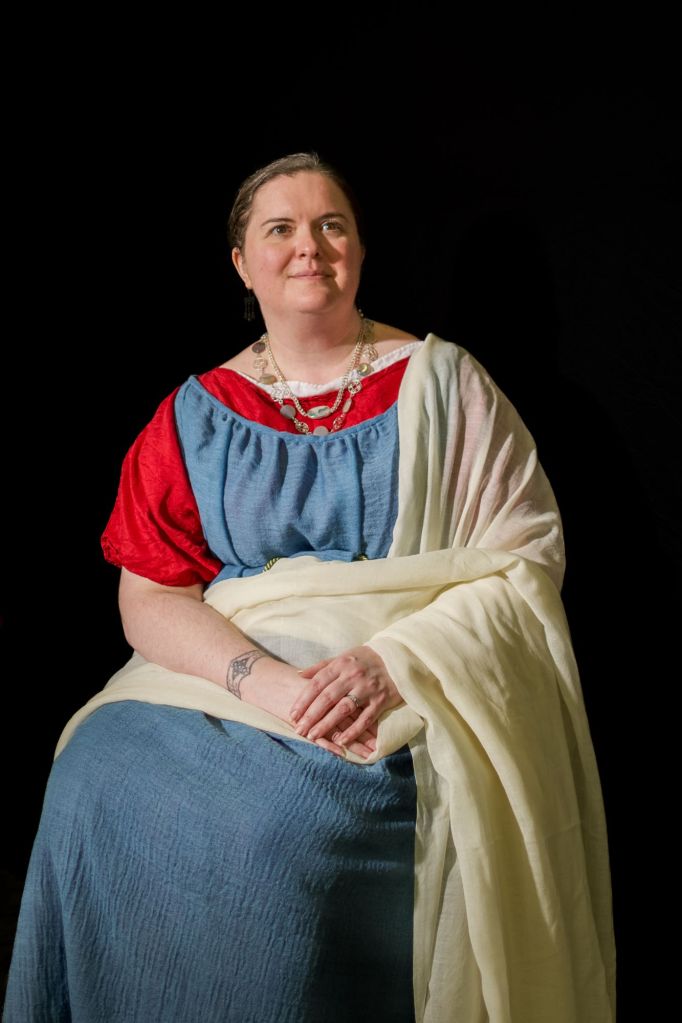
My current Roman kit (for the warmer side of shoulder seasons and summer) isn’t perfect, but I’m fairly happy with it. It starts with, well frankly, it starts with modern undergarments because I’m not up to putting on a strophium in the morning. A strophium is a linen band that’s, for me, about 5-6″ wide by about 3ish yards long that gets wrapped around the breasts like a strapless bra. And whether it acts like a bra or a binder is debated. I’ll get there eventually, I’m sure, because I’m curious, but I’m also sure it’s never going to be a regular part of my garb.
Anyway, moving on. We start with a white linen subucula, cut as a close fitting tunica recta. As in, only a scant few inches (3-4) more than my widest measurement, which happens to be my hip. Ankle length-ish, with a slit in one side for walking. I currently make this by folding the linen in half using the selvages for the top and bottom edges, cutting a slit for one arm on the fold, and seaming the other side, leaving the other arm hole open, as well as the walking slit. I believe the linen tunic is period, my construction is modern.
This layer is followed by a silk tunica, either a wider tunica recta or a tunica chirodota (with sewn in sleeves). I use vintage saris that are plain (no dots or patterns) with the trim cut off for my silk. The material is debatable. There are enough references to silk in period to make it plausible for a very wealthy persona, depending on the decade (it went in and out of fashion and availability). By the third century CE, for example, it was literally worth its weight in gold. I’m going for earlier than that, however. It’s really probably not completely right, but also maybe not completely wrong, depending on how wealthy I want to pretend to be. The silk is relatively affordable, and drapes really well. I have plans to make additional tunicas out of wool (definitely what the majority of tunicas were made out of in period), both tropical weight that I could wear now in spring, as well as heavier weight for winter; I also want to make a few out of mid-weight linen. These are largely for layering and for camp-wear. I think that they’re also period. Even though the statues and frescoes show us all the lovely draping and folds that comes from gauze and open weave fabrics, there’s written evidence and Coptic finds of heavier weight linen. The Coptic ones, for the most part, post date my period of interest, but not by a whole lot for some. Some artwork would lend itself to the idea of heavier weight fabric, as well.
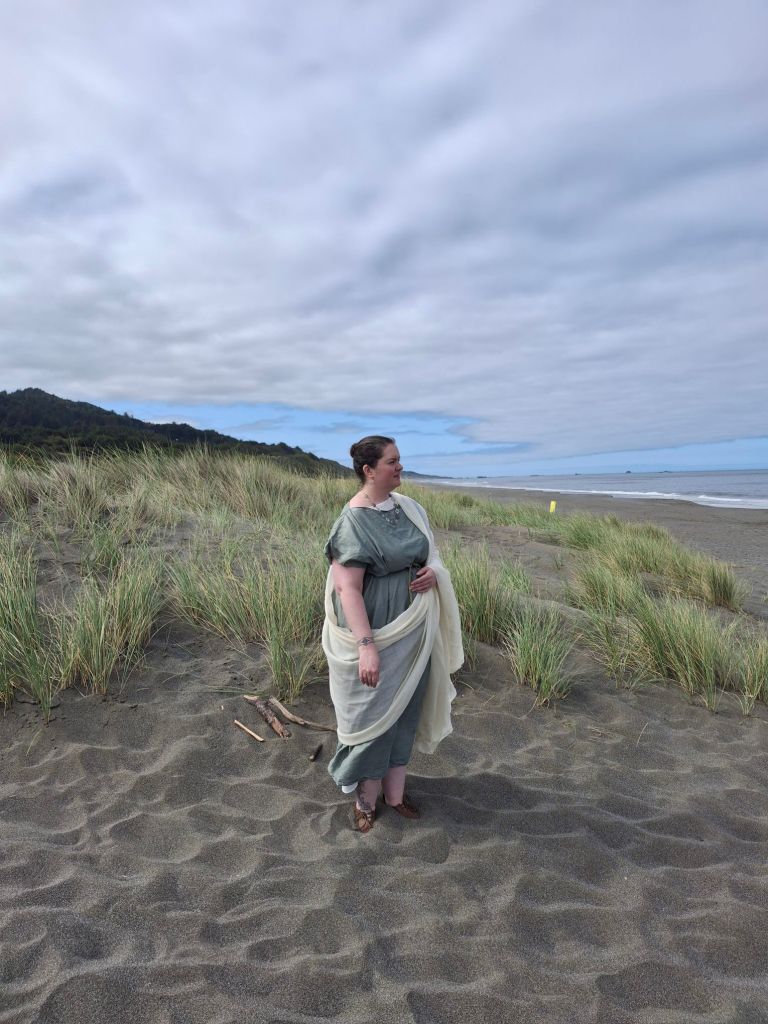
Moving on, currently I only have one stola, and I made a tragic mistake when making it. I focused too much of my research on what the top of it looked like, and neglected the bottom. The length. I cut it woefully too short, not realizing that the things were worn double belted and bloused. *hangs head* Do what I say, not what I’ve done! This layer ought to be at least 20″ longer than it is. Thankfully, the palla hides my shame. You can’t really see what’s happening, or not happening, as it were. The glorious side of this stola is that it’s indigo dyed wool gauze, dyed by my friend, her Grace Jac (OL) of Northshield. Now, I don’t always wear the stola, because I like the late first century CE when the stola was going out of fashion.
Edit 5/25/26: I didn’t do it wrong! A friend of mine (Duchess Livia, OL, An Tir) shared a photo with me of a banded, pleated stola on a statue that looks exactly like mine. It’s floor length, not double belted. And she taught me a very important lesson: no one “always” did anything a single way.
Topping it all off is a wool gauze palla. Four yards of fabric draped like a giant shawl around the body. Wool gauze has become my favorite fabric on the planet. There’s not much to say about the palla, other than that it, unlike the stola, stays in fashion FOR EVER. Shawls are stylish like that.
Shoes are currently most usually my old latchet shoes. Not the most correct for Roman. But they’re comfortable. I have a pair of modern sandals that blend, but aren’t that comfortable, so I don’t wear them often. And I’m nervous about buying calligae online, but I’m going to eventually, if I can’t find a pair at An Tir West War this year.
Resources: so far, I’ll be honest, my main resources have been other people. Dulcia’s Roman Closet and Romana Sum have been invaluable. (If I had paid slightly more attention to Tullia at Romana Sum, I wouldn’t have made that danged stola mistake!) I’ve also spent a lot of time studying Roman art in the form of statues, frescoes, and Fayum mummy portraits (mostly for the jewelry). I’ve read a few articles that honestly haven’t been particularly helpful, but I’m most excited to have two books on their way to me right now. Roman Clothing and Fashion, by Croom and The World of Roman Costume by Sebesta.


Leave a Reply