This is a topic dear to my heart. I was having a casual conversation with some friends a year ago, after getting deep into making Roman jewelry, but not having researched Roman jewelers all that much. I made the offhand comment that there weren’t any Roman female goldsmiths. But as soon as the words left my mouth, the assertion bothered me. I had no way of knowing if I was right. So I did some digging. And lo. I was (so happily) wrong! It’s contested, but there are several women with grave inscriptions indicating “aurifex”, literally, “goldsmith”. The most famous of which is Pompeia Helena.
It’s contested by one author, whom I haven’t read, John K. Evans, who suggested that aurifex may, in this context, mean “keeper of gold items”. However, Clemente Marconi, in The Oxford Handbook of Greek and Roman Art and Architecture, takes it for granted that women goldsmiths existed (p 125). Personally, I side with Marconi. Aurifex (on the grave, per Wikipedia, it literally says “aur (i) ficis” which is the “nominative, accusative, or vocative plural form of the third-declension masculine noun aurifex” (Google)) is used in the masculine form, rather than the feminine. There is surely another Latin word out there that better translates into “bearer of gold” or “keeper of gold”, and would show up in the feminine form. I think that women were doing the goldwork.
Additionally, Jack Ogden, in Jewelry Technology in the Ancient and Medieval World, discusses gender. “Sweetest daughter Vincentia” was a Roman “gold weaver” who died at just 9 years and 9 months old. (p 345) We don’t know exactly what a “gold weaver” was. She most likely literally woven gold into cloth, probably silk. At nine years old, she was working with two of the most expensive materials in the economy. We also see, per Ogden, husbands and wives who worked together as gold beaters. (Brattiarius/brattiaria). These were skilled artisans who made gold leaf and gold sheet.
These examples of women with job titles that are related to goldsmithing, but are not “aurifex”, further strengthen my belief that if “bearer of gold” or “keeper of gold” were specific jobs, that’s the title that would have been used, rather than the masculine word for goldsmith. It moreover strengthens my belief that Pompeia Helena was doing what might have even then been seen as a traditionally masculine job, and actually making jewelry.
Of note, one of the other women that Marconi sites is Sellia Epyre, a 1st century aurivestrix. Note the different job, note the feminine nature of the job name. It’s been translated, per Wikipedia, to mean gold embroiderer. I would, with my extremely limited knowledge of Latin, guess embroidery on clothing? It’s a step too far from goldsmithing for me, though not for Marconi.
I wish that I had more than two real sources on this topic (plus Wikipedia). There are several books on my wishlist, but they keep getting bumped for jewelry books. Also, my wishlist book are about Roman women generally, because that’s what’s there. I don’t know what more I’m going to find on this topic, in particular. I’m definitely open to suggestions!
-
-
I am Elizabeth Blackburn in the Society for Creative Anachronism, local to the Barony of Stromgard, kingdom of An Tir. I am a seamstress and metalsmith who works primarily in fine silver. Technically, I am a goldsmith even though, fun fact: I’m allergic to gold! You will never catch me working with it, however I do make jewelry, predominantly Roman.
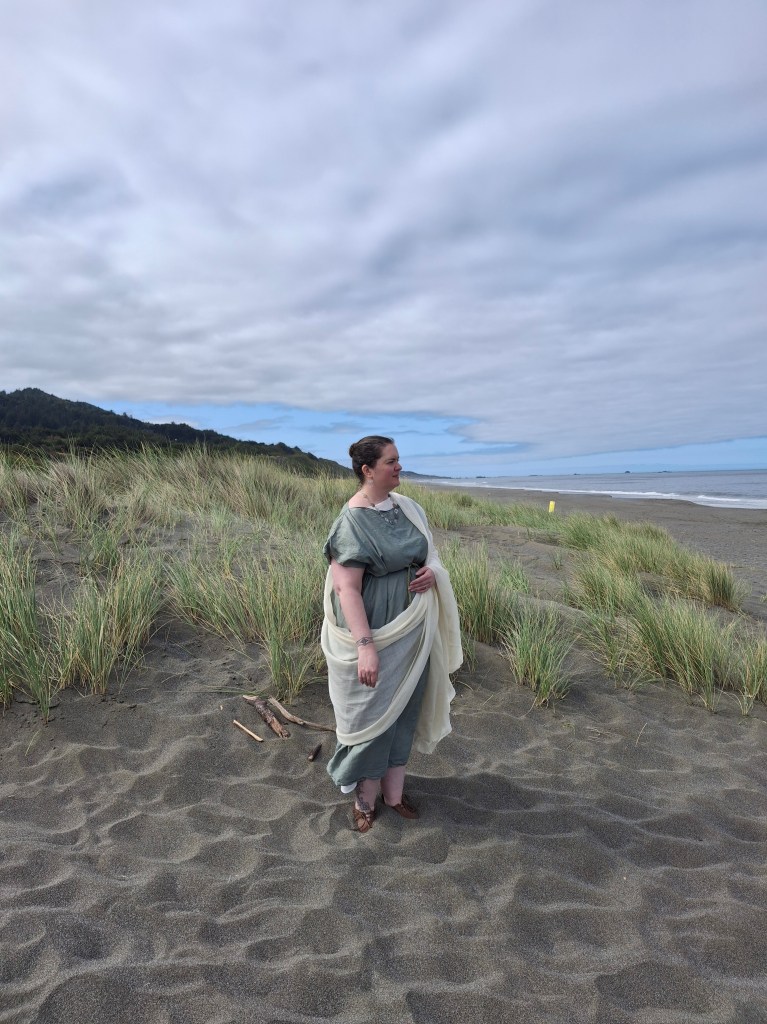
There were female goldsmiths in Imperial Rome! We know this thanks to epitaphs that indicate profession. While some have posited that women with certain crafting professions were, rather than the makers, sellers or custodians of the finished product. However, there is little more than misogyny to support that claim. I believe, based on my resources, that there were female craftspeople in Imperial Rome, including goldsmiths.
It is far less likely that there were female goldsmiths in medieval England. There were definitely seamstresses, though!
Why “Seams like a lady”? Because my real passion is construction, rather than patterning. Not that all of my garb is hand sewn, or even hand finished (I have a day job, after all), but most of it is hand finished, and my Roman is all hand sewn. It’s been a minute since I’ve visited my sewing research, as I’ve been focused more on metal, but as I’m at the beginning of a new set of 14th century garb, having outgrown my old clothes, I’m getting back into it.
Expect to see some of my old blog posts, from seamslikealady.blogspot.com, to show up on here, but also expect to find class handouts, (new and improved) tutorials, and lots of progress pics on this site!

